Onchain infrastructure for risk transfer. One institutional-grade architecture.
Every protection instrument — catastrophe bonds, collateralized reinsurance, and sidecars.
The Convergence
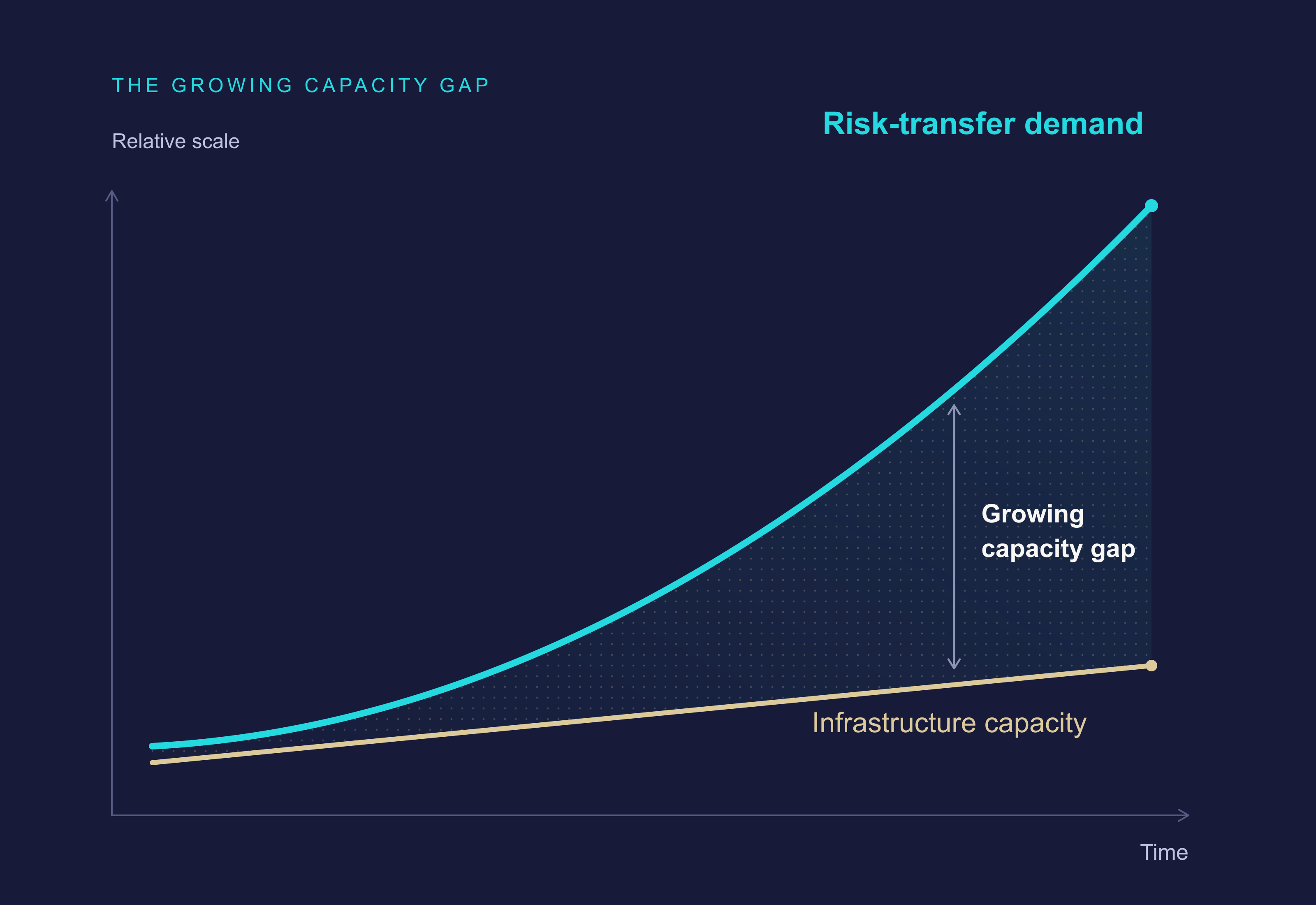
Three trends are converging and pointing to a structural shift in how the world transfers risk.
Risk transfer is ready to be rebuilt.
What was once bespoke can now become liquid, scalable, and fast.
The Protocol
At its core, RIZK is a single shared architecture: two linked vaults that together function as an onchain special purpose vehicle that you can run every ILS instrument on.
The premium-yield vault holds the premium flow; the protection-collateral vault holds the payout flow. Each vault issues two onchain positions, independently transferable through the coverage term.
The Benefits
One vault system connects risk and capital, improving how each side enters, participates, and benefits. What each side gets:
Additional capital alongside traditional reinsurance channels.
Settle in seconds, not months.
Protection can be transferred, fractionalized, or restructured onchain.
Returns driven by physical risk, not rates or equities.
ILS benchmark, 2015–2024.
Standardized vault positions that plug into Decentralized Finance.
Applications
Chokepoint protection is the first application in active design. Below, the other risk categories the same two-vault architecture extends to — conceptual today, on the horizon.
Corporate P&L coverage for maritime chokepoint disruption — a risk with real demand and no conventional insurance answer.
Global trade moves through a handful of maritime chokepoints. When any one closes or slows, the impact ripples through shipping companies, manufacturers, utilities, and retailers — most of whom retain 100% of the downstream risk because conventional products don't cover the knock-on P&L effects.
War risk covers hull damage; cargo covers goods in transit. Neither covers the rerouting costs, shipping rate spikes, or supply-chain delays that follow a chokepoint event. That gap is the risk this vault transfers.
Tokenized parametric cat bonds for earthquake, hurricane, typhoon, and wildfire — the largest ILS category.
The largest ILS category — named-peril parametric cat bonds for natural catastrophes. The same two-vault architecture applies: objective triggers from sources like USGS, NOAA, or satellite remote sensing replace broker-mediated loss adjustment.
Fractionalizable tokens collapse the $250K traditional minimum, opening the asset class to allocators priced out of conventional cat bond issuances.
Parametric coverage for systemic cyber events — cloud outages, BGP disruption, ransomware waves.
Cyber is the fastest-growing ILS category — Beazley's $300M deal in 2025 was the largest to date, with Chubb entering alongside.
The same two-vault architecture applies: verified infrastructure metrics (cloud SLA breach, BGP disruption, outage duration) replace contentious loss adjustment with an objective trigger, and tokenized positions bring secondary liquidity to a category where it's effectively zero today.
Index-based coverage for climate-exposed sectors — agricultural drought, renewable energy shortfall, tourism.
A sidecar-friendly configuration of the architecture, pooling many small policies under a single vault. Meteorological stations, satellite observations, or climate reanalysis data supply the parametric trigger.
The WFP R4 initiative and CCRIF Caribbean pool are decades-old operating precedents for this category — RIZK brings the same logic onchain with continuous liquidity and sub-$1K fractional positions.
ETH-denominated coverage for Ethereum validators, node operators, and LSTs — triggered by the beacon chain itself.
A DeFi-native application of the same two-vault architecture. The beacon chain itself is the oracle — slashing events are recorded onchain, making this the cleanest parametric trigger possible, with no external data source required.
A direct path between DeFi capital pools and the multi-billion-dollar validator and LST insurance market, with premium, coverage, and payout all denominated in ETH.
The Roadmap
The litepaper defined the architecture. The next 12–18 months bring it onchain with real risk, real capital, and regulated legal wrappers.
Bermuda segregated cell and Singapore SPRV pathways in parallel. Smart contracts deployed to testnet. KYC/AML token gating via ERC-3643.
First onchain risk transfer executed. Parametric trigger live. Institutional capital onboarded. Automated settlement tested at scale.
Cat bond and sidecar configurations deployed. Secondary market for tokenized positions. Exchange listing (SDAX / SGX).
RIZK means sustenance, provision, or blessing.
Whether you're an institutional risk holder, a capital allocator, or a protocol — we'd love to hear from you.
Get regular protocol updates and early testnet access.